01 — Initiation
The first move feels huge.
When a task has too many possible starting points, even a simple thing can become impossible to begin.
ClearStep is a CBT-informed app that turns “I know what I should do” into one clear thing you can actually do.
No blank journal. No endless reflection. No giant list of things you should fix. Just the next step.
You already know you should clean the room. Send the email. Go outside. Wear the T-shirt. Make the call. Start the task. Knowing isn't the missing piece. Starting is.
When a task has too many possible starting points, even a simple thing can become impossible to begin.
Covering up, postponing, checking, escaping, or simply deciding “later” gives short-term relief — and keeps the loop alive.
Your brain jumps from the next action to everything that comes after it. Suddenly step one feels like step ten.
Unless something remembers where you stopped, every return can feel like starting the entire process again.
You choose what kind of situation you're facing and how much you can handle. ClearStep turns that into a concrete action. You can stop after one step, save your progress, and come back when you're ready.
Getting started, avoiding something, or feeling overwhelmed. No perfect explanation required.
Barely, some, or ready. The goal isn't to prove how much you can do. It's to find a step you can approach.
One step is shown at a time. Upcoming steps stay out of sight so the whole staircase doesn't become another source of overwhelm.
Complete a step, stop for now, or try again. Your progress can be there when you return.
ClearCore is the decision system we're building underneath ClearStep. The goal is simple: instead of giving everyone the same advice, ClearCore should understand where you are, what is keeping you stuck, what you tried, and what the next appropriate step should be.
I was diagnosed with ADHD and social anxiety as an adult — later than most, and after years of not having a name for why certain things felt so much harder than they seemed to for everyone else.
Once I had the diagnosis, I went looking for tools that could actually help day to day. What I found were apps built around journaling, reflection, and open-ended questions — useful for some people, but exactly the kind of thing my brain struggles to engage with.
I didn't need something to ask me how I felt. I needed something to tell me what to do next.
ClearStep is the tool I wished existed: no blank pages, no long sessions, just a clear next step, built around how ADHD and social anxiety actually show up day to day. If that sounds familiar, I built this for you.
ClearStep started with a very simple frustration: knowing what I should do wasn't enough to make doing it easier.
Progress is not the same as completion.
If you tried to move forward, you already moved.
A step that you couldn't finish can still be useful. An attempt tells us something. A difficult day doesn't erase the work you did. ClearStep is built around movement, not perfect streaks.
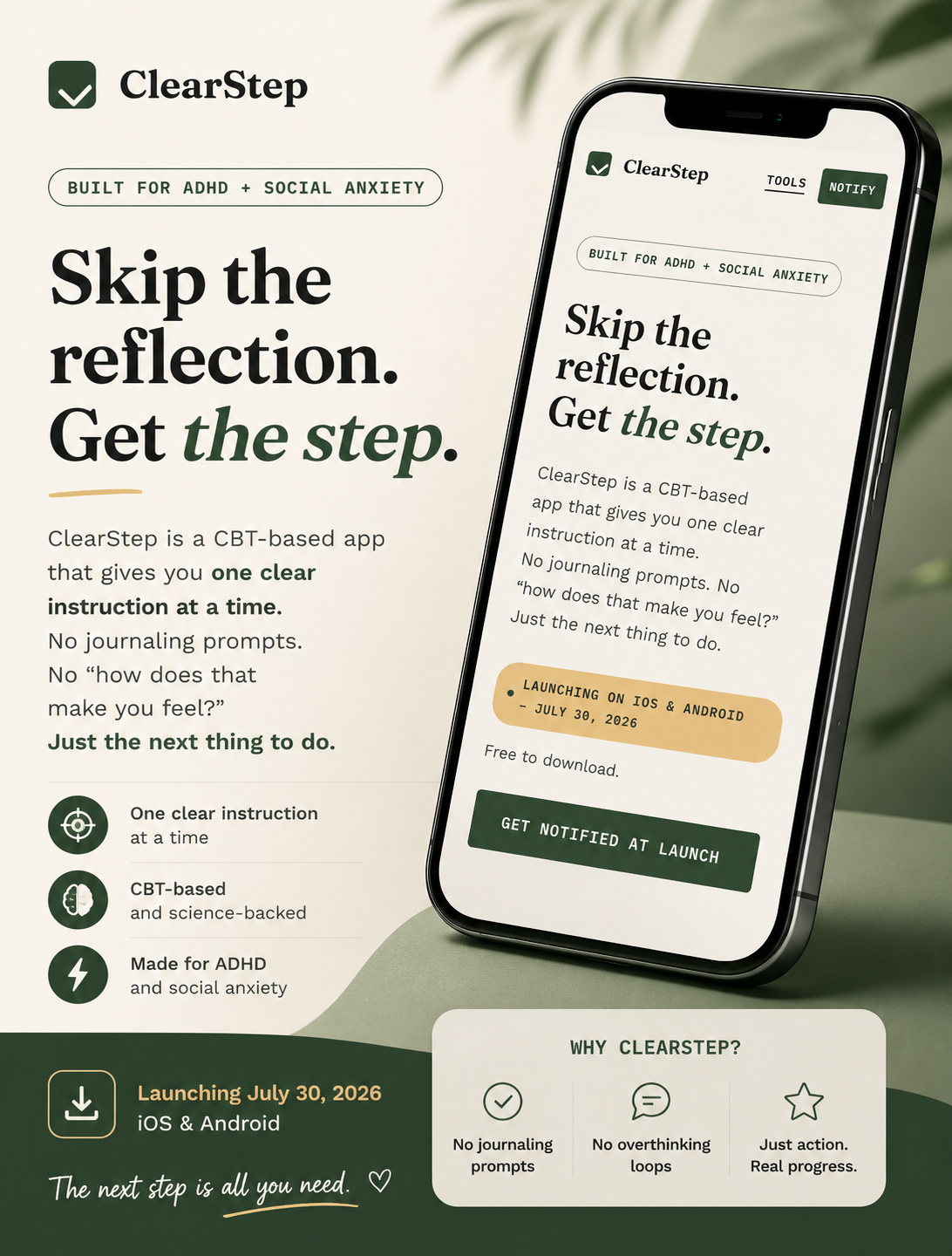
ClearStep is designed for the moment when you already know the advice, but getting yourself to act on it feels like a completely different problem.
Instead of another page asking you to reflect, ClearStep tries to make the next action obvious enough to start.
ClearStep is being built step by step. Sign up for occasional updates about new features, ClearCore development, beta releases, and what we're learning from early users.
No daily emails. No spam. Just meaningful ClearStep news.
By signing up, you agree to receive occasional ClearStep news and product updates. You can unsubscribe at any time.
ClearStep's Android beta is available now. Download it directly and start with one clear step. iOS is coming soon.